

GlassesUSA.com is the fastest growing, leading online eyewear retailer in the United States. It was built on the belief that eyewear should be affordable for all and offers a variety of high-quality designer and private label brands, designed in-house in a wide range of styles.
The company is on a mission to change the way consumers purchase their eyewear needs, relies on data and technology to optimize operations, and unlock opportunities to more effectively serve its customers, and continues to innovate the industry with tools that further the brand's mission.
Learn about the users' experience [steps, actions, emotions] when purchasing prescription eyeglasses in a physical store.
Understanding the pain points experienced by users when purchasing prescription eyeglasses in a physical store.
Understand the relationship between the eye exam stage and the actual shopping process.
Understand the impact a salesperson can have on a user's journey and decision-making
1:1 Remote [via Zoom], Semi-structured user interviews with 5 participants
Recruiting Research Participant: Male / Female, Ages 25-65, Live in the USA, Have purchased prescription eyeglasses in the past year from a physical store.

Vision insurance and the convenience of a one-stop-shop experience appear to be of importance yet do not come on account of fashion and style. Our participants are willing to invest more effort to find a place with frames that suit their needs.
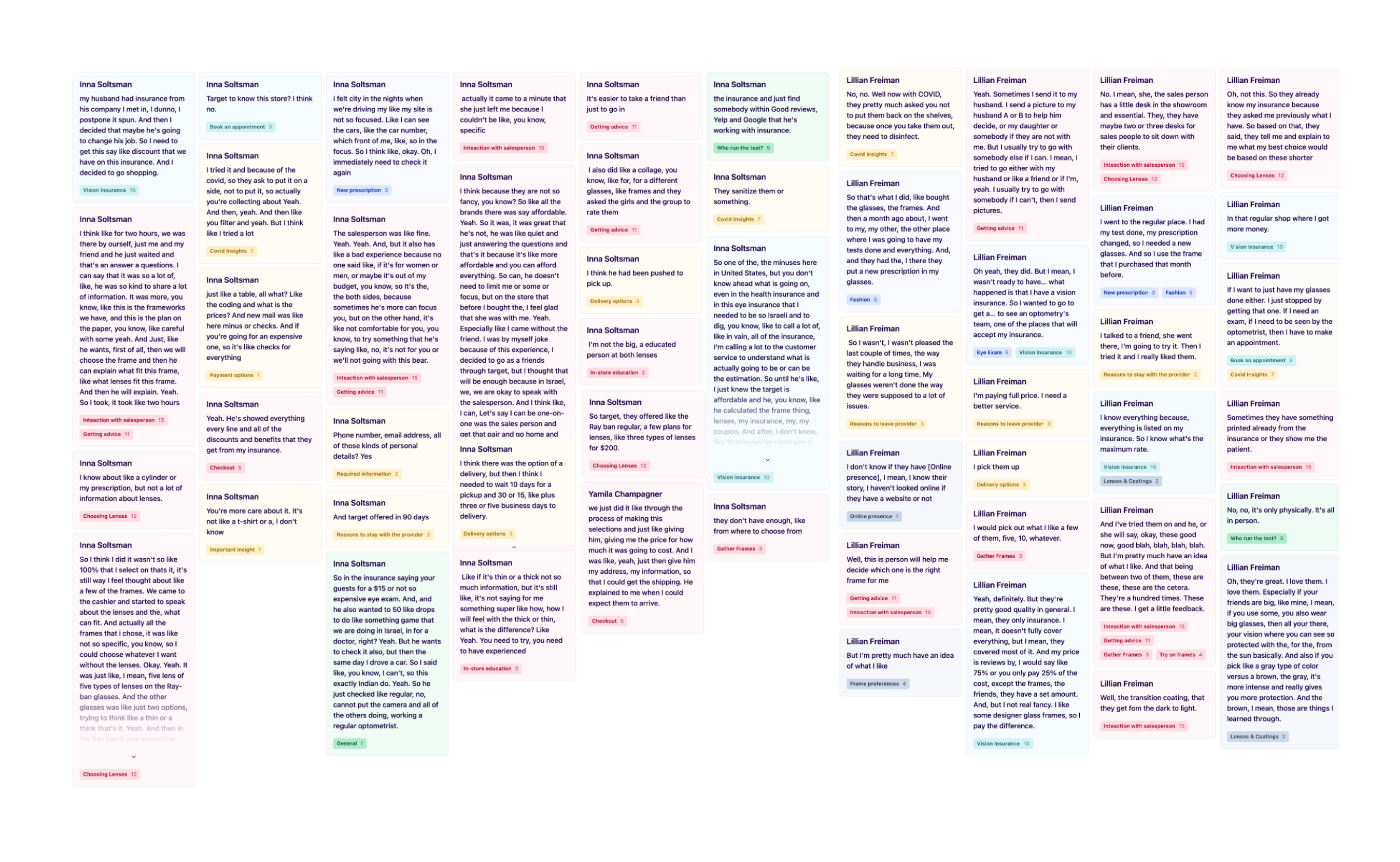
Contrary to what we used to believe, conducting an eye test and choosing a store to purchase your prescription eyewear from are two separate entities with different sets of expectations, which in the majority of cases are not happening in the same place.
Approachable and trustworthy service, professional knowledge, 1:1 attention, and a wide range of prices, appear to be the most important variables in the decision-making of where to shop your eyewear, and it usually does not align with the requirements of a place to conduct your annual eye exam. In this use case, our participants were guided by the combination of proximity to their place of living, acceptance of vision insurance, maximum refund, and social reviews.
"And even though I didn't have exam yet for new prescription, I said, you know what? I want these glasses. I’m gonna buy them, I'm gonna later have them put in the prescription I need״.
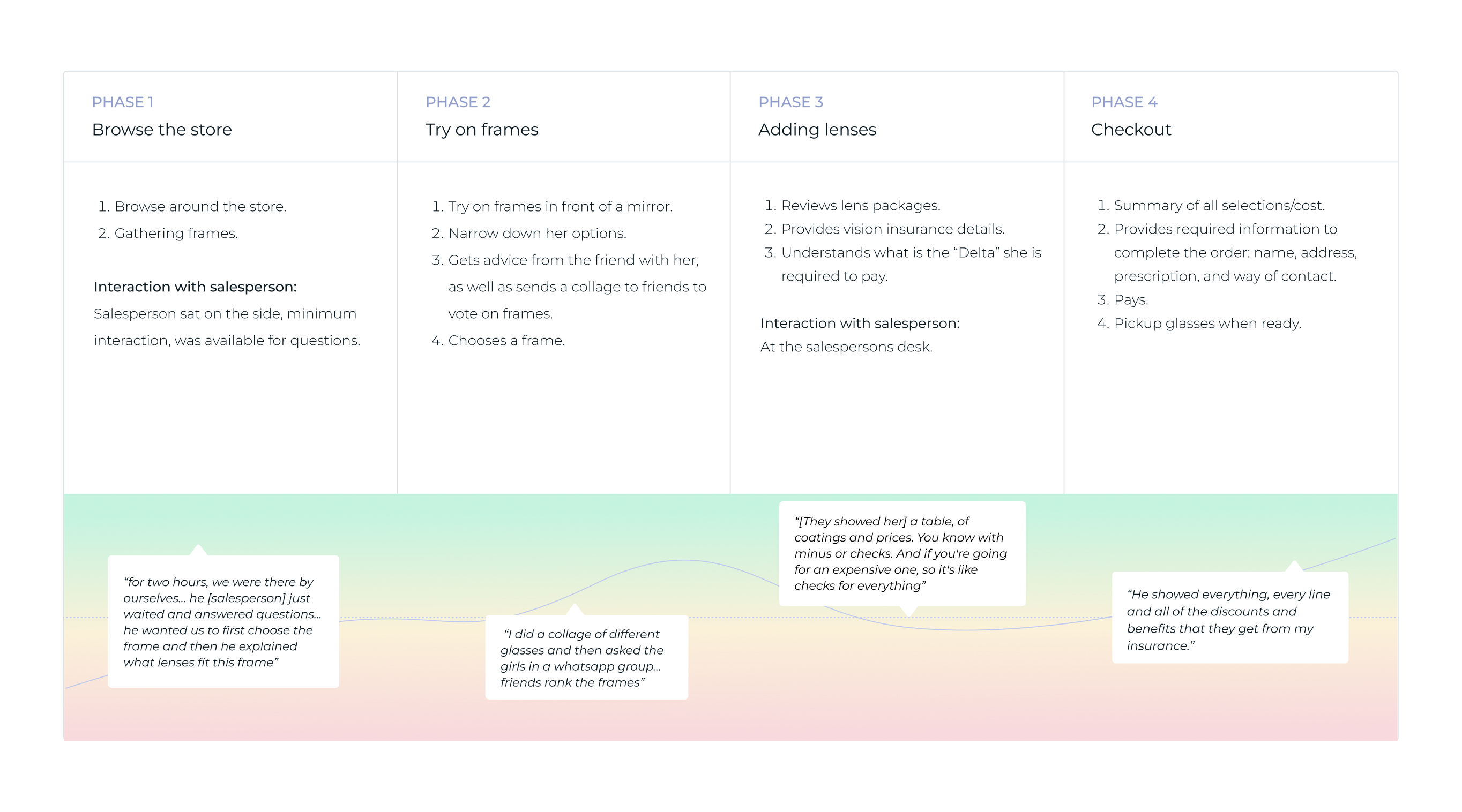
The need for advice came up across the board amongst all our participants. Some users felt comfortable receiving advice from the salesperson, but even so, they needed to have the opinion of at least one person from their close circle who they trust.
Participants do so by bringing someone along with them or sending selfies with the frames they liked. One participant went as far as to create a collage of frames and sent it to a WhatsApp group of friends to vote on. This overall behavior has made it clear that people actively seek assurance from others during the purchasing phase.
״I did a collage of different glasses and then asked the girls in a WhatsApp group… friends rank the frames”.
As we talked with participants about how they applied these benefits in relation to the total amount to be paid, all of them pointed to the same difficulty. The discounts were calculated manually, in the "old-school" way, using a calculator, pen, and paper. It was a long process that took more than a few minutes, exposed to human mistakes and not so much trustworthy.

During the interviews, we noticed that a significant part of the participants' visit duration is dedicated to their interaction in front of the mirror: trying on frames, consulting with a friend, or a salesperson, taking selfie images to help with their decision-making process, etc.
One of the biggest challenges when trying on new frames is in the absence of your prescription lenses. Depending on your prescription strength, that experience can be extremely frustrating for a big part of customers.

Mike wears the same prescription for the past 8 years, every year he schedules his routine eye exam but his prescription isn't changed.
Therefore his need for new glasses isn't strong as the other participants in this research, instead, he is raising a continuous pain point in the form of absence in a post-sale service. While he might purchase a new pair of glasses every once in a while, he mostly needs a place to provide him with service for wear, tear, and breakage of his current pairs.

Impact: Applying our digital knowledge can be a big advantage to the customers' journey in our store, a simple experience such as a “take a picture” option can help reduce this blind feeling, and replace them with positive ones.
Impact: Digitizing this procedure will solve the "delta" pain point, eliminate those unpleased feelings, and gain the users' trust and confidence.
💡 Vision insurance and the convenience of a one-stop-shop experience appear to be of importance yet do not come on account of fashion and style.
💡 Harnessing the new-prescription motivation when scheduling an eye exam for an end-to-end purchase experience will contribute to both customer convenience and to business goals, which can be only achieved by answering all of the user's expectations for each of these phases.
💡 Addressing the absence of a waiting area for an eye exam will provide both spare time and a much more open-minded approach for users to explore GlassesUSA.com new digital stand experience and our '60-second perfect pair quiz' [compared to the initial idea to place the stand at the store entrance].
💡 Applying our post-sale service [coverage, manufacture warranty] in a physical store can be real news to the eyewear market, and also an answer to an important pain point, that is potentially relevant to a big part of our target audience, further research is needed for scale matters.
💡 Covid-19 restrictions are still relevant, frames cannot be measured straight off the wall, they need to be sanitized before being available to someone else. I strongly recommend to address those restrictions by assigning a dedicated tray near each try-on space, to place the frames the customer want and don't want [Yes, No, Maybe].